David Jones – The Final Markdown
To download a PDF version of this update, click here.
As the jingle goes ‘there is no other store like David Jones’. Well, going forward it may be there is just no store. David Jones (“DJs”) has been placed into receivership as management, landlords and capital providers failed to find a workable solution to stave off collapse of the once venerable Australian department store owner.
While to some people this may appear somewhat sudden, it has been a ‘fait accompli’ to many in the industry given years of poor operating performance and the litany of department store failures around the world over the last decade.
Given our exposure to regional malls internationally, we have been well aware of the plight facing department stores and have been wary of the Australian situation for some time. It became clear to us in the past 12 months DJs was in its death throes. Together with share price strength, this was a significant driver in our decision to exit our exposure to mall landlords Scentre Group (SCG) and Vicinity Centres (VCX) which count DJs as a major tenant in many of their properties. Whilst not catastrophic, DJs rental income is typically less than 5% of most shopping centres and it has lost its cache in recent years, its demise will be disruptive to operating earnings and require significant capital to reposition, particularly for SCG, DJ’s largest landlord.
DJs was founded in 1838 and is reportedly the world’s oldest continuously operating department store still trading under its original name. Whilst a long and illustrious history, DJs decline has been evident for the past 10-15 years through multiple different ownership structures and recapitalisations, a failed international foray in the U.S. and more recently a steady decline under the control of both Woolworths SA (South African Woolworths – no relation to the Australian retailer) and subsequently private equity firm, Anchorage Capital.
As a department store operator, DJs is not alone in its challenges. Over the last decade numerous department stores in the U.S., UK, Europe and Canada, have faced restructuring, bankruptcy and in some cases liquidation¹. While it’s easy to point to the disruption wrought by e-commerce, or the COVID period, in reality the headwinds facing the department store model were building well before.
Historically, department stores provided brands with a route to market and for customers’ convenience. They were “the” showroom offering a broad but select range of goods under one roof. With attentive customer service, and in some cases credit, DJs created generations of loyal customers.
For landlords they were the key anchor of regional shopping malls, enjoying heavily subsidised rents in recognition of the footfall traffic and leasing power they brought to the centres they were in. Over time, that proposition has been whittled away.
Domestically the decline began with the emergence of the category killers, retailers which specialised and dominated a particular category such as Rebel Sport, JB Hi-fi, Harvey Norman, Mecca. These retailers attacked key categories of the department store and directly competed on price, range and customer experience. More recently, the fast fashion and off-price categories exploded with the arrival of dominant international brands such as Zara, Uniqlo, H&M, and TKMaxx. In addition, luxury brands created their own flagship stores, their products once the exclusive domain of the premium department store.
Mall landlords also contributed to the cannibalisation, identifying successful brands (e,g. Mecca, Sephora, Peter Alexander) unique to department stores and bringing them into the mall as individual specialty stores. This gave the brands control over pricing, merchandising and customer experience but ate away at turnover for department stores. Increasingly, the wholesale suppliers to department stores competed with their own boutiques.
The growth in e-commerce compounded the challenges. The efficiency of department stores having ‘everything under one roof’ was neutered as online shopping gave consumers a never-ending product assortment with price transparency anywhere anytime. The improvement in pricing and availability of delivery further pressured the customer proposition and introduced new competitors with enormous scale and efficiency such as Amazon. Not only were many department stores late to online, many were lacking the purchasing power and financial resources to compete effectively.
Reflecting the operating challenges, many department stores resorted to selling the property they did own such as their flagship locations to release capital for investment (or working capital), but in exchange taking long-term lease liabilities. David Jones walked this path under Woolworths SA, selling flagship locations at Bourke St in Melbourne and Market St and Elizabeth St in Sydney (notably the Elizabeth St store was acquired in 2020 by various Charter Hall vehicles including listed REIT CLW for $510m which obligated DJs to pay an annual rent of $25.5m increasing 2.5% p.a.). While this provided much needed capital, you can only sell the family silver once and if operating performance does not improve, the cashflow crunch will return.
While some commentators have suggested that DJs lease liabilities are a key contributor to its financial woes, the U.S. experience demonstrates that the primary challenge department stores face is poor retail trading performance. Many of the failed department stores in the U.S. such as Sears, Saks, and JC Penney owned a significant proportion of their store fleets, often gifted to them by the original mall developer to act as a leasing drawcard for the rest of the property. The P&L was not weighed down by rental payments, yet the businesses failed anyway due to structural headwinds, declining sales and insufficient capital.
Today DJs operates from 38 stores, all of which are leased, and according to press reports, some of which are unprofitable at the store level. While outright liquidation and closure of all stores is possible, there is strategic value in some of DJs locations (e.g., Chadstone, Bondi Junction, Chermside, Doncaster) which are secured by leases with rent levels meaningfully below market. If the business is acquired out of receivership, the business may be downsized and retrench to the most profitable locations, with press reports suggesting a reduced fleet of between 12-20 stores. Any restructure will require additional capital, and possibly some form of support from landlords. Whether this occurs or would be a sustainable solution remains to be seen, but it would provide landlords with more time to manage the capital and operational requirements of redeveloping vacant department stores.
From a listed REIT perspective, Scentre Group (SCG) is the largest landlord with 17 stores, Vicinity Centres (VCX) has 4, and GPT Group (GPT) 3. SCG is the most influential in the outcome, as it is both the largest landlord and the only listed landlord with credit protection in the form of ~$45m ($30m at share, equivalent to 8 months of gross rent) of bank guarantees, which were secured from Anchorage Capital during the purchase from Woolworths SA, and can be applied against any unpaid rent.
For VCX and GPT the income exposure is relatively modest in the context of their overall business, with DJs 2.4% of gross rental income for VCX and <1% for GPT. VCX also arguably has three of the most productive stores which would likely be retained in the event of a restructure, those being Chadstone, Queens Plaza Brisbane and Chatswood. Capital required to repurpose and re-tenant any vacant space, is also manageable for both VCX and GPT in the context of their overall portfolio size and balance sheet, with both having c. 30% loan-to-value ratios.
For Scentre Group (SCG), DJs represents 1.8% of rental income, 3.6% of EPS but ~5% of retail Gross Lettable Area (GLA) (~200,000 sqm). Similar to VCX, a reasonable proportion of SCG’s stores would likely be retained in the event of a restructure, but there will be fall out. In either scenario the income disruption is relatively modest, particularly given the bank guarantees SCG retains. However, the quantum of capital, operational complexity and disruption of repurposing 5% of GLA should not be dismissed lightly.
With an average DJs store size of ~10,000 sqm, each store reconfiguration poses challenges for landlords, not only affecting operating cash flows from DJs but disruption to surrounding retailers due to changed pedestrian flows and capital works needed to be carried out. For dominant assets where the physical structure readily accommodates repurposing and re-tenanting, redevelopment is more than likely a profitable endeavor. DJs rent averages $352 per sqm compared to SCG’s total portfolio average rents of $942psm providing a reasonable margin to account for the costs of repositioning. SCG has undertaken numerous projects in recent years where single department store floors (as part of downsizing initiatives e.g., Burwood, Southland, Tea Tree Plaza) or entire former department stores (e.g. Mount Gravatt, Tuggerah) were profitably redeveloped. However, some centres may struggle to attract sufficient high rent paying retailers to make the repositioning earnings accretive. Australia’s current economic situation of rising interest rates and falling house prices won’t help.
From a capital perspective, our assessment is that all the impacted listed REITs have the balance sheet capacity to fund the cost of repurposing the DJs space. Earlier in the year we assessed the capital required for SCG to repurpose all of its DJs space. Based on the development costs for the above noted department store redevelopments, we estimate a range of ~$3,000-$12,000 per sqm or $30m – $125m per store². The significant variation reflects the different scope of projects which often incorporate other works as part of the redevelopment. Even at the upper end of this range, the overall capital commitment for SCG (at share) would be less than $1.5bn which would increase gearing by less than 3% assuming no value creation (i.e., capital spent is simply capitalised one for one into asset values). Again, in a worse-case scenario of all stores being vacated, we believe SCG has more than sufficient balance sheet capacity to repurpose the DJs space.
The next consideration is more crucial: Is there sufficient demand to backfill vacated space at rents which make the redevelopment economic? Ultimately this will be asset specific, but landlords are at least starting from a position of strength with portfolios basically full (>99.6% leased for all listed landlords). Indeed, SCG believe the demise of DJs could open up an opportunity for the entry of large overseas retail brands that had hitherto been reticent to establish a presence in Australia given the lack of sizable available floor space. Retailers such as Lefties and Primark spring to mind, with both typically occupying 4,000sqm to 5,000 sqm. The availability of DJs better locations represents a rare opportunity to gain immediate scale. Nor would we rule out an attempt by serial opportunist Soly Lew to engineer a deal to merge and restructure Myer and DJs. Nevertheless, meaningful additional floor space in market could soften the demonstrable pricing power landlords are enjoying which has underpinned recent financial results.
It would remiss not to consider what this means for Australia’s other department store, Myer. Is it the next shoe to drop? It’s clear the concept is under pressure, and the question remains does Australia have the scale to support any traditional department stores? In a retailer environment of constant change and fierce competition no retailer is ever safe and the existential threat to the business model, which has killed many global peers of significantly larger scale, suggests Myer’s medium term survival is far from assured. The stock price has sunk over 90% from its 2009 IPO to less than 30c – things are far from rosy. Its balance sheet is OK but far from robust given the operating performance of the business which has been deteriorating since its IPO. While we don’t see imminent financial risk, further store downsizing and closures appear likely in an uphill battle to remain viable.
Myer – Annual Reported (Basic) EPS
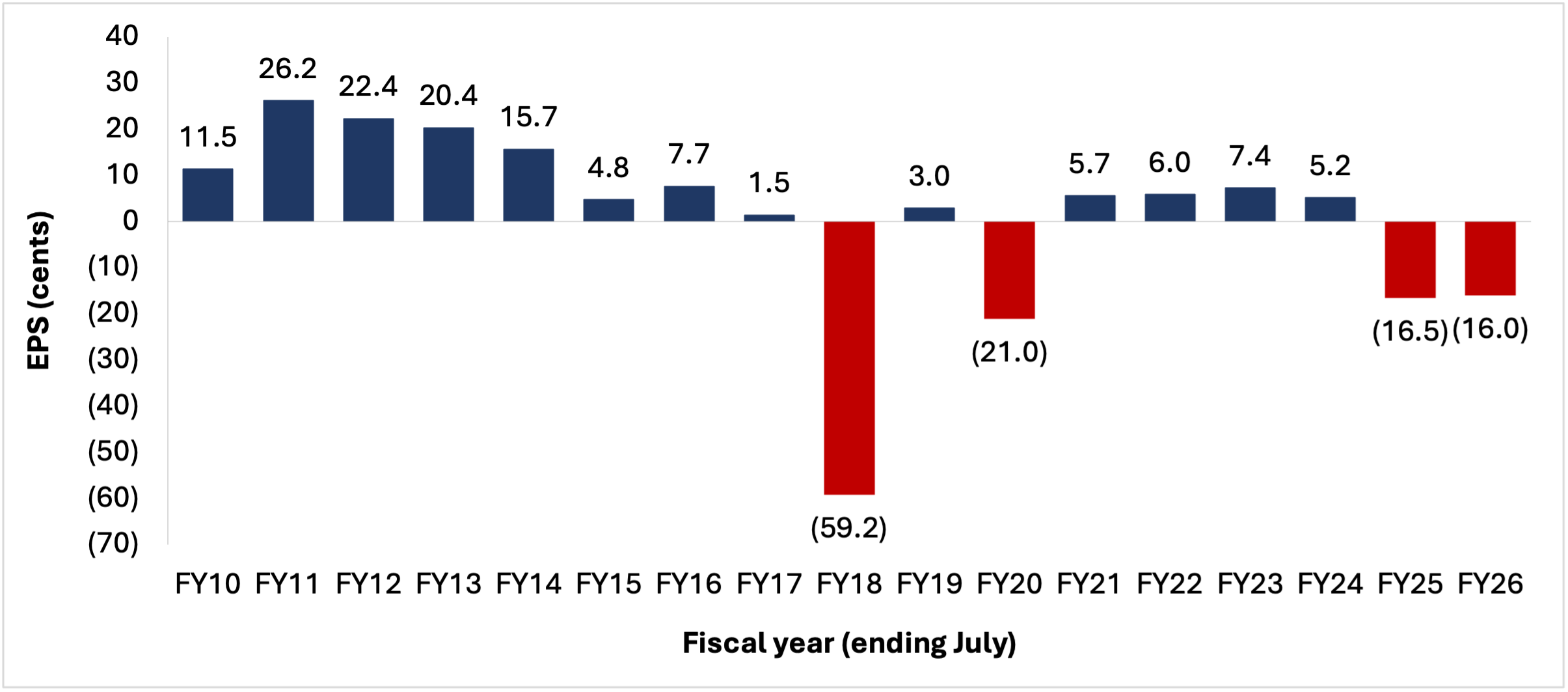 Source: Factset, ResCap, data is Myer Reported Basic EPS A$.
From a Resolution Capital portfolio perspective, we have been focused on this issue for some time, and while our assessment was that the capital required and income loss is manageable, equally we haven’t dismissed the operational complexity of redevelopment, or the potential deteriorating landlord pricing power as significant department store space returns to the market. As a result, the portfolio has no current exposure to SCG or VCX and currently a ~2% exposure to GPT.
The latest press articles tell stories of goods flying off the shelves at DJs, the problem is its suppliers attempting to rescue unsold inventory rather than customers preparing for the holidays.
It seems to us DJs is heading to Davey Jones Locker.
Footnotes
¹Storied names such as Saks 5th Avenue, Sears, Neiman Marcus, Hudson Bay, House of Fraser, and Galeria Karstadt Kaufhof have fallen by the wayside
²Based on an average store size of $10,000sqm at 100% ownership. NB: Of the 17 SCG malls with a DJs, 13 are co-owned in joint-ventures reducing the capital commitment.
Disclaimer:
This communication is prepared by Resolution Capital Limited (‘Resolution Capital’) (ABN 50 108 584 167, AFSL 274491). Pinnacle Investment Management Limited (ABN 66 109 659 109, AFSL 322140) and its associated entities (collectively ‘Pinnacle’) provide distribution and responsible entity services to Resolution Capital. This communication is for general information only. It is not intended as a securities recommendation or statement of opinion intended to influence a person or persons in making a decision in relation to investment. It has been prepared without taking account of any person’s objectives, financial situation or needs. Any persons relying on this information should obtain professional advice before doing so. Any opinions, forecasts or recommendations reflect the judgment and assumptions of Resolution Capital and its representatives on the basis of information at the date of publication and may later change without notice. Any projections contained in this communication are estimates only and may not be realised in the future. Returns from investments may fluctuate and you may not get back the amount you invested. Past performance is not a reliable indicator of future performance. No warranty is given as to its accuracy, reliability or completeness and persons relying on this information do so at their own risk. Subject to any liability which cannot be excluded under the relevant laws, Resolution Capital and Pinnacle disclaim all liability to any person relying on the information contained in this communication in respect of any loss or damage (including consequential loss or damage), however caused, which may be suffered or arise directly or indirectly in respect of such information. This disclaimer extends to any entity that may distribute this communication.
Unauthorised use, copying, distribution, replication, posting, transmitting, publication, display, or reproduction in whole or in part of the information contained in this communication is prohibited without obtaining prior written permission from Resolution Capital.
Resolution Capital is a Registered Investment Adviser with the United States Securities and Exchange Commission (CRD# 142409). Registration as an investment adviser with the SEC does not imply any level of knowledge or training.
This document does not constitute, or form part of, an offer to purchase or issue interests in any security or investment product.